
Does your garden have a pollination issue, or maybe you just want more birds and butterflies in there to add some life to the space?
Well, believe it or not, there are actually some flowers that can help you attract more birds and butterflies to your garden naturally! Today, let’s discuss them in detail. But first…
How To Choose Fast-Flowering Pollinator Plants?

First and foremost, when it comes to fast-flowering plants, you want to go for annuals or short-lived perennials (like zinnias or cosmos) for quick blooming results.
The plants you choose to work with should be pollinator-friendly, rich in nectar, and vibrant, ideally in shades of red, pink, yellow, or orange. To ensure consistent pollinator visits, deadhead spent flowers often and keep the plants tidy.
Fast-Growing Flowers That Attract Birds & Butterflies

1: Zinnia (Zinnia Elegans)

This annual offers round, vibrant blooms in pollinator-friendly shades like red, pink, yellow, and orange. They bloom in as little as 6-8 weeks and are super useful for attracting bees, butterflies, and hummingbirds to the garden.
Tip: Deadhead spent zinnia blooms often to encourage reblooming.
Want even more blooms? Here’s how to feed your zinnias for bold color and nonstop growth.
2: Cosmos (Cosmos Sulphureus)

Cosmos flowers are already up and blooming within 7-9 weeks of planting. They work surprisingly well for attracting butterflies thanks to their nectar-rich petals and bright orange/yellow color.
Tip: Cosmos prefer lean soil for the best growth. Soil that is too tightly packed and rich is no good to them.
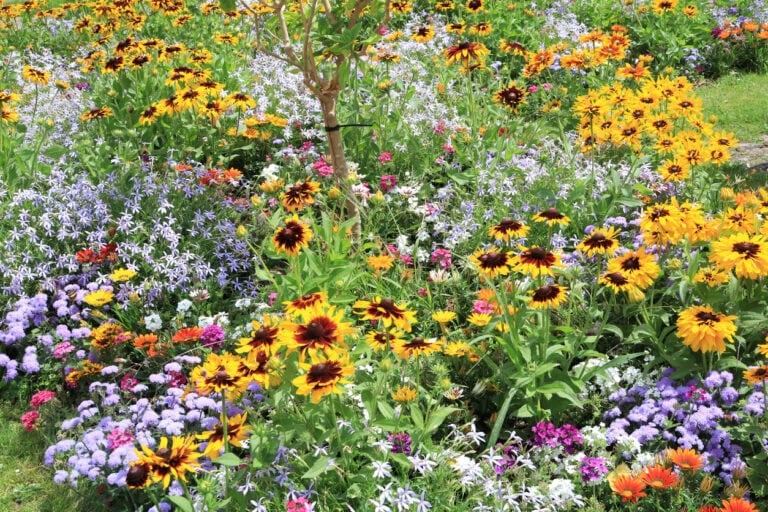
3: Black-Eyed Susan (Rudbeckia hirta)

Black-eyed susans are fast-growing flowers that bloom roughly 6-8 weeks after planting and are bright favorite in pollinator-friendly gardens.
Their bold yellow petals and dark centers attract butterflies all summer long, and once they go to seed, birds like goldfinches love to snack on the dried flower heads.
Tip: Black-eyed susans thrive in full sun and tolerate both drought and poor soil conditions with ease.
Looking for more options? This guide highlights native flowers that pollinators truly love.
4: Sunflower (Helianthus annuus.)

Sunflowers are classic pollinator powerhouses. Butterflies are drawn to their wide, sunny faces early in the season, and birds love feasting on their seed heads as the flowers fade.
Tip: Direct sow sunflower seeds in full sun after the last frost. They sprout quickly and grow fast with very little effort.
5: Nasturtium (Tropaeolum Majus)

Nasturtiums are known for their fast growth and climbing habit, making them pretty useful for enhancing overall garden aesthetics. Their bright red, orange, yellow, and purple flowers are perfect for attracting various kinds of pollinators.
Tip: Higher soil fertility or soil that’s high in nitrogen can lead to more leafy growth and fewer flowers.
6: Coreopsis (Coreopsis Spp.)

Coreopsis are early bloomers that start blooming in about 8-10 weeks of sowing. They offer daisy-like, vibrant flowers that are absolutely loved by pollinators.
Tip: Deadhead your coreopsis consistently to prolong blooming.
If you’re planting for pollinators in the Midwest, these native flowers are essential.
7: Bee Balm (Monarda Spp.)

Bee balms begin blooming in early summer, and their nectar-rich, tubular flowers attract pollinators quite effectively. While they’re not the fastest to bloom from seed, starting with young transplants will give you quicker color and more reliable results in the first season.
Tip: Plant bee balms in full sun and water them deeply and regularly.
8: Coneflower (Echinacea Purpurea)

Coneflower is a perennial that begins to produce flowers in the first year of planting. Its cone-shaped flowers are loved by pollinators, and because they’re so vibrant and showy, they can be seen from afar, meaning pollinators are unlikely to miss them.
While coneflower can bloom in its first year, it tends to grow slowly from seed. For a quicker payoff, start with nursery transplants.
Tip: Trim spent echinacea blooms timely to encourage a new flush of blooms immediately after.
To keep blooms coming, here’s a quick deadheading guide just for coneflowers.
Before You leave… Here Are Some Common Mistakes To Avoid

Before planting, make sure you’re not adding any of these sneaky invasives to your garden.
Let’s Conclude

While plants and flowers are the core pillar of a garden, pollinators like bees, butterflies, and birds are the supporting pillars without which the main pillar cannot stand for long.
Short on space? These container-friendly flowers still bring in the butterflies.
Every gardener must recognize the importance of pollinators in the garden and deploy some techniques to lure them in. The simplest and most effective technique is just planting the right, pollinator-friendly flowers and letting them work their charm.



thanks for the information, but i’ll need it next year for i’ve not planted flowers this year. i have my seeds for next year already and can hardly wait. i still need the information on christmas cactus, mine is needing some help. i have it outside for the summer but it is shedding all of it’s new growth. help
Hi Phoebe 🙂 Don’t give up on it yet! When a Christmas cactus starts dropping new segments, I usually look first at too much direct sun, heat, or watering problems. Outdoors for summer is fine, but it does best in bright filtered light rather than hot direct sun. Check that the pot drains freely, let the top inch of soil dry before watering again, and don’t let it sit soggy or bone dry. Once conditions are steadier, the new growth should stop dropping.