

Who says you need a garden to grow your own flavorful seasoning?
Even as someone with over fourteen years of gardening experience, I didn’t always have my own outdoor space. But I always had something growing that I could cook with.
I’ve tried my hand at growing all sorts of herbs indoors and I noticed that the easiest way to keep them alive longer is by growing them in water.
If your outdoor space is small (or non-existent) and your green thumb still needs a bit of perfecting, here are some herbs that you can grow in water all year round.
11 Herbs You Can Grow In Water All Year Round
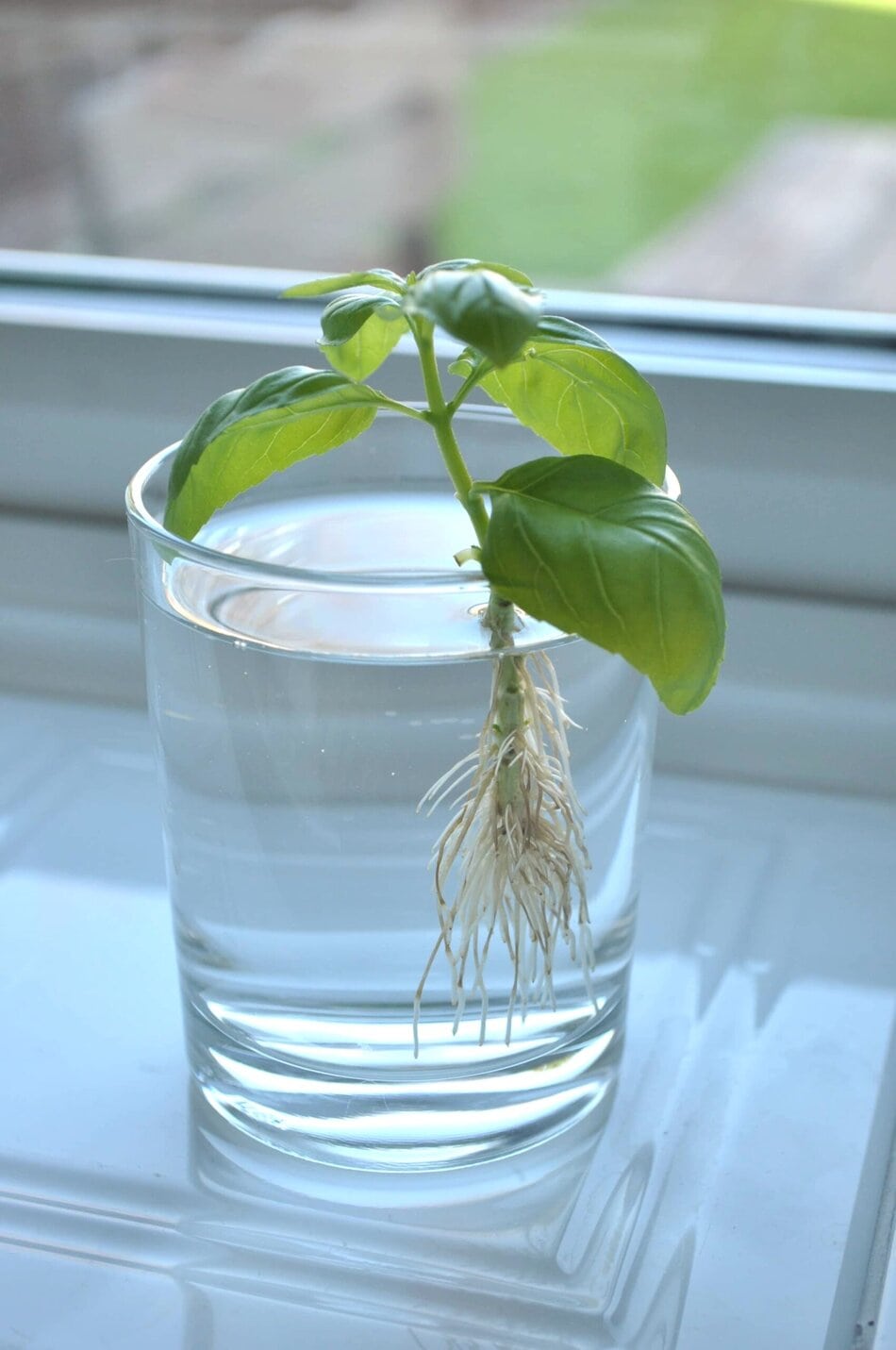
After years of trial and error, these are my favorite herbs to grow in water indoors.
1: Thai Basil (Ocimum basilicum var. thyrsiflora)

If you’ve tried and failed to grow supermarket basil in water, you’re not alone in your frustration. I did too. Allow me to introduce you to Thai basil, its more robust cousin. It has a fresh anise flavor with a bit of spicy aftertaste. We can use it both fresh (it’s really strong though, so sprinkle it sparingly) or cooked in stir fries and stews.
How to grow it in water: Take a healthy cutting, remove the lower leaves, place the stem in fresh water, and keep it on a bright, sunny windowsill. Change the water every 2 days.
Both types are annuals in the garden, but I found that I can overwinter Thai basil in water indoors in the cold months. And even grow it indoors all year long.
2: Thyme (Thymus)

Thyme is a staple in any kitchen, and luckily very easy to root and grow in a jar of water indoors. In fact, it will even turn the water into amazingly fragrant thyme water. It’s that strong!
So if you find it fresh in supermarket herb blends (my favorite is bouquet garni). Thyme likes sunny locations, so a south-facing windowsill will keep it happy and growing.
How to grow it in water: Strip off the lower leaves, place the stems in fresh water, and keep them on a sunny windowsill. Change the water every 3 days and expect slower growth than softer herbs.
If you’re planning ahead for colder months, we also put together a zone-based guide on herbs that grow well indoors all winter.
3: Purple shiso (Perilla frutescens)

If you want to cook with a really unique-tasting herb, I highly recommend trying purple shiso. Its flavor is a mix of cumin (but more subtle) followed by citrusy afternotes.
You can get this herb from Asian stores and garden centers or you can buy it as part of a sprout mix and grow it from seed.
It has a sturdy, fast-growing stem with plenty of growth nodes which makes it an excellent candidate for growing in water. Plus, it’s so pretty, and it will fit right in with your houseplant collection.
How to grow it in water: Take a fresh cutting, remove the lower leaves, place the stem in water, and keep it in bright indirect light. Change the water every 2 days.
4: Winter Savory (Satureja)

Even if you haven’t heard of winter savory before, I guarantee you’ve had it in herbal mixes, the most popular of which is Herbes de Provence. Savory tastes a little bit like thyme, but with less of the bitter aftertaste.
We can grow savory in water due to its woody stem, but only if we remove the leaves off the piece of stem that we’re submerging. This way, the exposed leaf nodes will turn into growth points for the roots.
How to grow it in water: Remove the lower leaves from a woody stem cutting, place it in fresh water, and keep it in a bright location. Change the water every 3 days.
5: Mint (Mentha)

Mint is insanely easy to grow in water, as long as we remember to refresh the water every few days. So my challenge for you is not to grow it, but to see how many types you can collect.
In addition to the classic peppermint and wintergreen mint, my favorites also include chocolate mint (excellent in brownies), strawberry mint, ginger mint and green apple mint.
If you’re tight in space, you can grow them in the same glass or pitcher, but I advise you to keep them separate, as much as possible. The flavor seeps into the water and all the other types of mint that share the water will absorb it.
How to grow it in water: Place fresh cuttings in water, remove any submerged leaves, and keep the jar in a bright, sunny spot. Change the water every 2 days and keep varieties separate.
If you like the idea of growing herbs in jars, we shared a full list of herbs that do especially well in mason jars with almost no setup.
6: Catnip (Nepeta cataria)

Catnip is sometimes casually called catmint, but Nepeta cataria is the true catnip, the one that makes many cats giddy due to a compound called nepetalactone.
Other Nepeta plants often sold as “catmint” may be ignored by cats, but catnip definitely isn’t. If you have cats, it’s best to keep your jar somewhere they can’t reach.
Just like mint (which it shares a family with), nepeta develops a sturdy stem that makes it a good candidate for surviving in water. Remember to refresh the water regularly.
How to grow it in water: Take a healthy cutting, remove the lower leaves, place the stem in fresh water, and keep it in a bright spot. Change the water every 3 days and keep it out of reach of cats.
7: Lemon balm (Melissa officinalis)

Another member of the mint family, lemon balm makes an excellent addition to refreshing drinks, both warm (such as tea blends and hot chocolate) or cold (lemonade). I also like to sprinkle it on salads, pasta and cake.
When you’re growing lemon balm in water, the best way to harvest it is by alternating between picking the side leaves (which keeps it growing upwards) and pinching the tops (which helps it branch out). Try to space your harvest evenly and not just pick from one spot.
How to grow it in water: Place fresh cuttings in water, remove any submerged leaves, and keep the jar in bright light. Change the water every 2 days for steady growth.
How you harvest really matters with water-grown herbs too, so we wrote another article explaining which herbs actually need regular pruning to stay healthy.
8: Lavender (Lavandula)

Speaking of a good addition to lemonades and cakes, have you tried lavender? If you think the taste is a bit too strong to use in cooking, try drying it first.
Lavender roots easily and grows well in water due to its woody stems. Although I found that English lavender (Lavandula angustifolia) works better than French lavender. Keep in mind that your lavender will probably not flower in water as it would outdoors in the garden.
How to grow it in water: Take semi-woody cuttings, remove the lower leaves, place the stems in fresh water, and keep them in a bright spot. Change the water every 3 days and focus on rooting, not flowering.
9: Rosemary (Salvia rosmarinus)

If you’re an absolute newbie at growing herbs in water, I advise you to start with rosemary. It’s very forgiving. It isn’t the fastest herb to root in water, but it’s one of the most reliable once it does.
We have to strip the leaves off the stems that we’ll put in water and remember to change the water regularly. And for the first couple of months, until it starts growing serious roots, don’t harvest from the top of the plant.
How to grow it in water: Remove the lower leaves from a healthy stem, place it in fresh water, and keep them in bright light. Change the water every 2 days and avoid harvesting until roots form.
Since light plays such a big role indoors, we also put together a list of herbs that truly thrive on a sunny windowsill.
10: Sage (Salvia officinalis)

Sage is the quintessential winter herb. I start using it heavily around Thanksgiving and keep it in my kitchen as a trusted cooking companion all the way through Easter.
Just like mint, sage also comes in deliciously diverse cultivars. My favorites are pineapple sage (excellent in drinks), lemon sage (for salads) and honeydew melon sage (for desserts).
How to grow it in water: Take fresh cuttings, remove the lower leaves, place the stems in water, and keep them in a bright spot indoors. Change the water every 3 days.
11: Tarragon (Artemisia dracunculus)

Tarragon leaves have a delicate licorice flavor with a sweet aftertaste. It goes really well in soups, stews and sauces, and I’ve even successfully infused it in vinegar.
Tarragon grows just as easily as rosemary and if you have the choice, make sure you buy French tarragon to grow in water. It’s a bit more forgiving of neglect and definitely more flavorful.
How to grow it in water: Take young cuttings, remove the lower leaves, place the stems in fresh water, and keep them in bright indirect light. Change the water every 1 to 2 days.
After years of growing herbs indoors, these are the ones I always come back to. They root easily, tolerate water well, and keep producing with minimal effort. Whether you grow one jar or a full windowsill, this method makes fresh herbs possible year-round.
And if you ever decide to move some of these herbs into soil, we also wrote a guide on the best herbs to grow in containers, even if you only have a small balcony.




I just moved into a studio and currently own an aerogarden, going to try all of these.
Hi Vanessa! That sounds amazing! 🌿✨
An aerogarden is perfect perfect for growing herbs in a small space. You’re going to love having fresh flavors all year round! Hope you have fun trying them all. Let me know how it goes! 😊🌱
Thank you!!
Hi Lisa! You’re very welcome! 😊🌿 Hope you have fun growing your herbs. Happy gardening! ✨
Will try the easy ones:) How are your herbs standing up straight in the jar, and not flopping over to the sides of the jar?
Hi! Great choice! 😊
For herbs to stand up straight in the jar, make sure they have enough stem support, trim them to a good length and remove any lower leaves. Placing several cuttings together helps them stay upright, and using a narrow-necked jar or glass can give extra support. You can also tie them loosely with a string or use small stones to stabilize the stems. Hope that helps! 🌿
Greetings. I would like to buy herbs and spices seeds. Where can l buy seeds for black pepper and cloves. Thanking you in anticipation.
Hi Reginah!
Black pepper and clove seeds can be a bit harder to find, but you might have luck with online stores like Baker Creek Heirloom Seeds, Rare Seeds, Johnny’s Selected Seeds, or True Leaf Market. Some larger retailers like Etsy, Amazon, and even The Home Depot or Lowe’s may also carry them seasonally. Hope that helps, and happy growing! 🌿✨
I would love to try these, but I’m skeptical of little flying gnats. How can I avoid them?
Hi Kathy! Great question! 😊
To avoid gnats, make sure to change the water every few days to prevent stagnant conditions where they thrive. You can also add a drop of hydrogen peroxide to the water or place a small layer of sand or pebbles on top of the water to deter them.
Keeping the area clean and dry will also help! Hope that helps, and happy growing! 🌿✨
Glad I came across your page!
Hi Kathy! So glad you found it! 😊 Hope you enjoy the tips. Happy growing! 🌿✨
Love your knowledge and tips! Thank you!!! Would love to save this information for sun placement of herbs. My sage and basil and one mint plant already died so will try them in water. Can you use sprigs for this type of growing from grocery store herbs?
Hi Michelle! Thank you so much! 😊🌿
Yes, you can absolutely use grocery store herb sprigs for growing in water! Just choose healthy, fresh stems, remove the lower leaves, and place them in a glass of water in bright, indirect light. Basil and mint root especially well this way! Hope your next batch thrives. Happy growing! 🌱✨
Can you put multiple herb varieties in the same container?
Hi Janice! Yes, you can! 😊 Just make sure the herbs have similar water, light, and soil needs so they thrive together. For example, basil, parsley, and cilantro love moisture, while rosemary, thyme, and oregano prefer drier soil. Give them enough space so they don’t compete for nutrients. Happy planting! 🌿✨
Hi, can they be grown in plastic vases ??
Hi! 😊 Yes, plastic vases work fine! Just make sure the herbs get enough light and you change the water every week or so to keep it fresh.
Thanks for these great tips. We live in Florida now so looking forward to trying out several herbs you recommend 😀
Hi Bobbi 😊 Florida is perfect for herbs, you’re going to have so much fun with it. I’d start with basil, mint in its own spot, oregano, and rosemary, and just give them a bit of afternoon shade during the hottest months so they don’t get stressed.
Hi Rita. Can I use fresh herbs sold in supermarkets as starters for my little hydroponic herb garden?
PS you rock ❤️
Hi Pamela 😊 Aww thank you, you rock too. 🫶
For supermarket herbs, it can work but it depends on the herb. The “fresh bunches” are usually cut stems, so only the ones that root well from cuttings will take off (basil and mint are the easiest). Snip just below a node, strip the lower leaves, root in clean water first, then move to your hydro setup once you see a good little root system!