

I still remember the first time my snake plant flowered. It’s weird, because it was almost fifteen years ago, but it’s one of those memories that sticks vividly in my mind because of how fragrant the blooms were. My sansevieria flowering was an unexpected surprise, since I didn’t know snake plants flowered at all.
I’ve had multiple rounds of blooms on my snake plants by now, so I’ll let you in on the secrets on how to make a snake plant flower.
But first, let’s get on the same page. Whether you know it as a mother-in-law’s tongue, a Saint George’s sword or a sansevieria, just know we’re talking about Dracaena trifasciata. It used to be classified as a Sansevieria trifasciata, but that classification has recently changed.
How to Get a Snake Plant to Flower
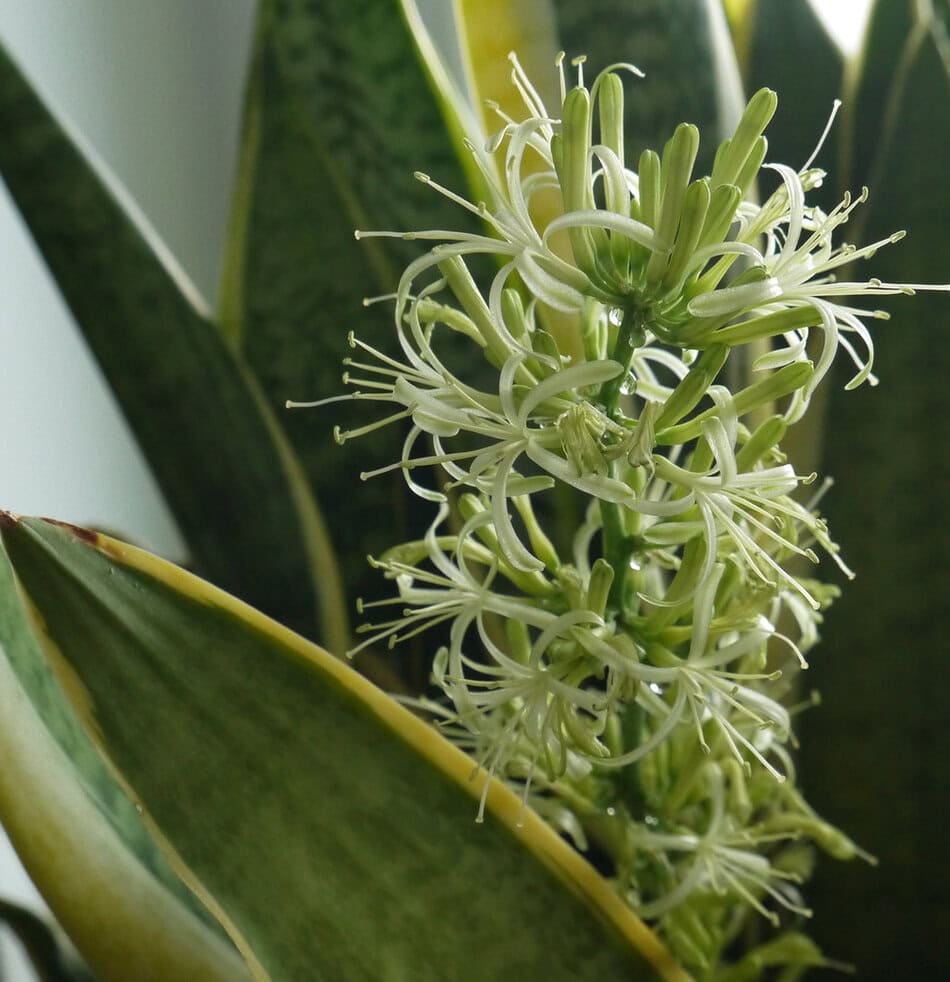
Snake plants can flower once a year, usually in spring, although their flowering period might stretch to early June (that’s when mine decided to bloom a couple of times.)
The snake plant blooms start off as pale green, then turn creamy white as they open up. This happens over several nights, as the flowers are actively releasing fragrance in the evening.
And speaking of fragrance … it’s absolutely intoxicating! Imagine a combination of royal lily, hyacinths and gardenia perfume, then imagine it ten times stronger. Fortunately, the blooms are only fully open at night, so all I have to do is close the door on them when I go to bed.
How Can I Encourage My Snake Plant to Flower?
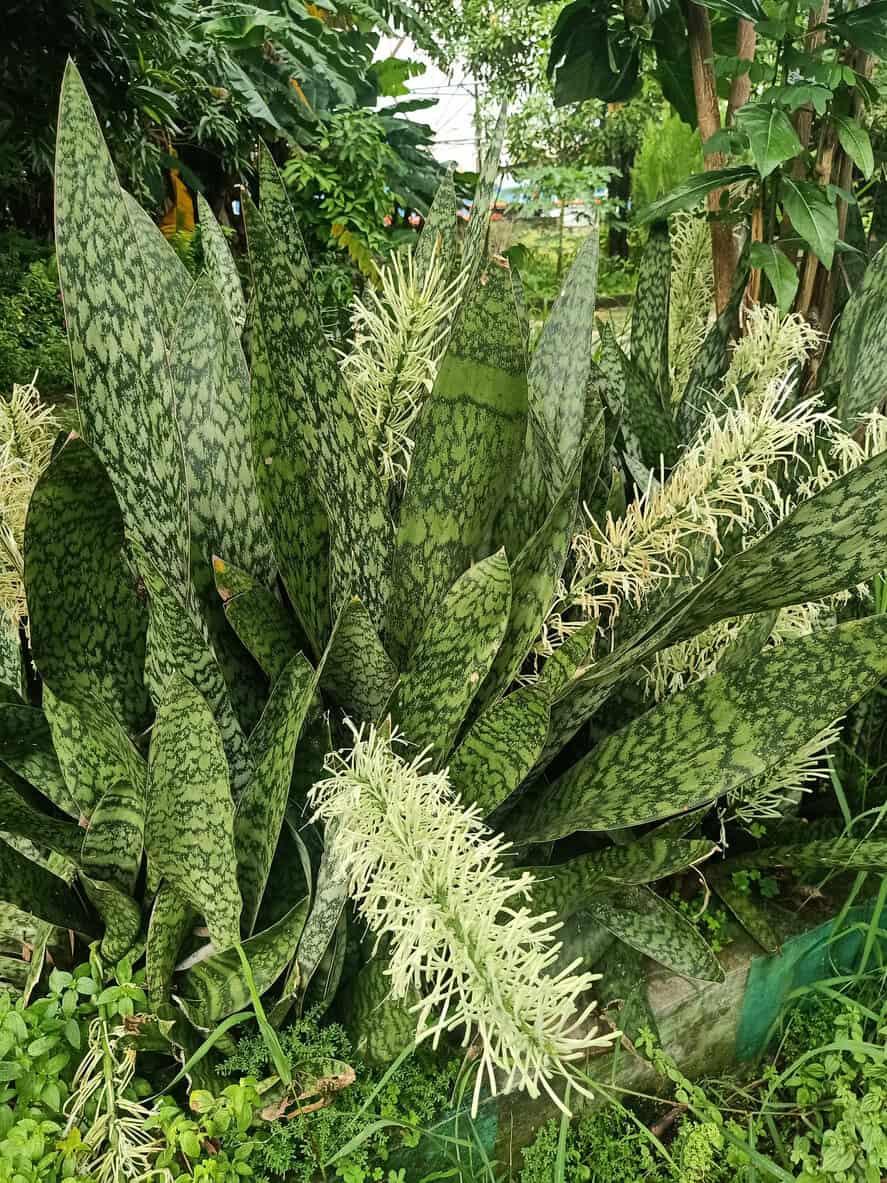
If you want your snake plant to flower, you’ll need to recreate one of these two slightly different growing scenarios.
Why? You may ask… That’s because snake plants grow in a wide range of natural habitats in West and Central Africa, ranging from full sun to shaded forest floors. So trying to replicate their ideal conditions can look wildly different.
Scenario 1: Snake Plants Flower When They’re Doing Really Well
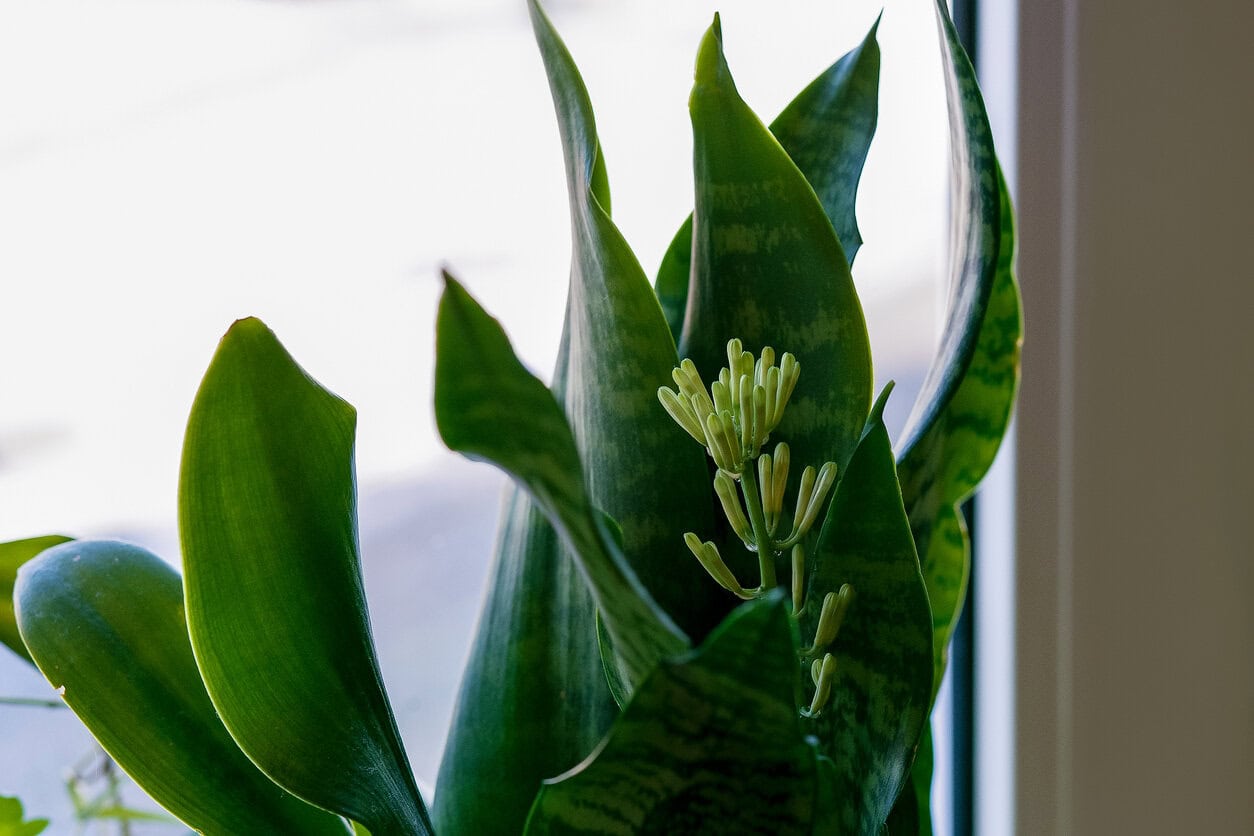
In spite of the fact that it’s marketed as a plant that thrives on neglect, this plant merely tolerates neglect, but does not thrive on it.
Side note: I found that even when people without a green thumb claim that they’re completely neglecting their houseplants, that’s not entirely true. They don’t baby them, but the plant still gets the right amount of basic care to put out blooms.
Which brings me to the two factors that happy snake plants have in common:
How Much Light Does a Snake Plant Need to Bloom?

Snake plants need about five to six hours of bright indirect light to bloom. In the Northern Hemisphere:
A good way to tell:
Lower yourself to the level of your plant and look out the window. Can you see the sky? If you can, the light might be bright enough. If you can’t, nudge the plant closer to the window until you can see the light.
How Much Water Does a Snake Plant Need to Bloom?

Once again, we look at how the plant grows in its natural habitat. Snake plants get watered when it rains. Then stay dry. Then get watered when it happens to rain again. So it’s not as much about the quantity of water as it is about the frequency.
Snake plants don’t like having wet feet and are not used to a constant stream of moisture. This is what we should mimic in our home! That’s why it’s important not to water on a schedule, but only by observation.
This is what I do:
Wait until the potting soil has dried out. Then soak the plant really well, allowing for the water to percolate out of the pot through the drainage holes. Then set it aside and only water it when the soil dries out again.
Quick reminder: As snake plants exit their winter dormancy, they’ll accelerate their growth and need more frequent watering as the days get longer and warmer.
Scenario 2: Snake Plants Flower When They’re Slightly Stressed

There’s this widespread myth that you need to stress your snake plant in order to induce it to bloom. I hate to break it to you, but over-stressing your snake plant will only result in a weaker plant.
Considering how much energy flowering takes, a super-stressed plant simply won’t have the resources to produce blooms. That said, we’re not trying to actually stress the plant, but rather create a slightly restrictive environment instead.
Basically, the kind of ‘stress‘ we’re aiming for comes from growing these plants in indoor conditions that are very different from their natural habitat.
How to slightly stress your snake plant?

One of the ways snake plants propagate is through rhizomes. They send underground shoots that grow into another plant.
When the plant becomes pot-bound, and it doesn’t have enough room to send new shoots, that’s when it will try to propagate a different way – namely through flowering.
This is what I do:
Keep the snake plant in a pot where it is a bit snug, which can encourage a plant to bloom. The trick is to give it just enough stress to trigger blooming – but only IF it gets enough light and if its roots aren’t rotting (the two factors we talked about above).
But don’t keep it so constricted that you force it to bust through the pot (which can divert energy away from flowering).
So rest assured, just because your snake plant is blooming, it doesn’t mean it’s stressed and dying.
How Long Do Snake Plant Flowers Last?
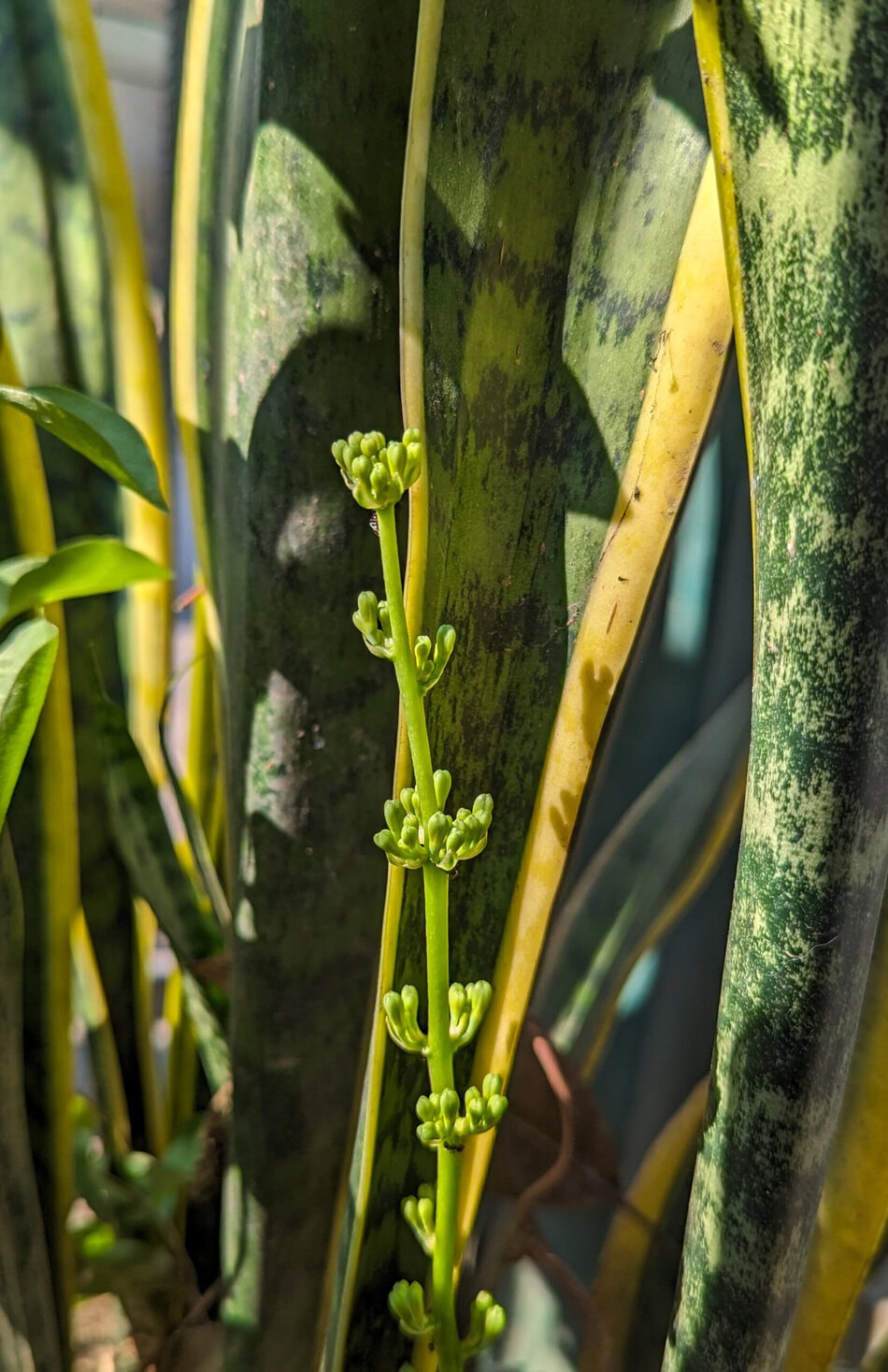
That’s the exciting part. A single flower usually lasts for a day or two. But the inflorescence, which takes several weeks to develop, has many flowers along the stem. This means that a single stem can have buds going in and out of bloom for a good month before it’s done.
What Should I Do With a Snake Plant After it Flowers?

In the wild, snake plant flowers turn into orange berries. Don’t expect that to happen in our living rooms though, since fruit formation is the result of pollination.
Once the flowers are done, you can simply cut off the flowering stem at soil level.
You might want to grab it with a tissue, since the buds are very sticky. That sticky residue is the nectar that would have attracted the pollinators if your snake plant were growing in its natural habitat.
If your plant is extremely pot-bound, consider upsizing its container, but only by a little bit. You can repot it in a container no more than a couple of inches larger in diameter.
Quick Tips to Get Your Snake Plant to Flower

In conclusion, here’s the TLDR of how to encourage a snake plant to bloom:
Once you recreate the right conditions and give it a bit of time, your snake plant may surprise you with blooms. Fingers crossed you’ll get to experience that moment soon too.






Thank you thank you
Hi Catherine! You’re so welcome! 😊 Wishing you the best of luck getting that snake plant to bloom, it’s such a special surprise when it does!
My Jade plant and my snake plant bloomed at the same time.
P
Hi Phillips! 😊 Wow, that’s amazing! Both blooming at once is such a rare and beautiful treat, your plants must be super happy!
My snake plant has bloomed but I didn’t know jade bloomed.
I got Jade plant and snake plants both are struggling don’t know I tried all thingd
Hi Rupi! 😊 Oh no, that’s so frustrating, I know how it feels when nothing seems to work 😞 Both jade and snake plants like bright, indirect light and well-draining soil, and they really hate staying too wet. Maybe try letting the soil dry out a bit more between waterings? Sometimes less is more with these two! They can be picky!
I have a snake plant that was my mother’s. It’s about 80 years old now and has been propagated many, many times. It has flowered many times as well. For about 5 years in a row, it bloomed. It literally grew so much that it burst through the pot. I was forced to re-pot and propagate it once again. I place it in my basement in the winter under a grow light. During the Spring and Summer months, I place it on my patio in partial shade. I enjoy it so much!
Hi!😊 Wow…80 years old?! 😮 That’s incredible! What a beautiful way to keep your mom’s plant thriving through generations. It sounds like you’ve absolutely nailed the care, blooming for five years in a row is no small feat! I love that it’s part of your seasonal routine now too. Thanks for sharing that, so inspiring!
My cutting of a snake plant has grown to be about 4ft high and starting to lean, what do you suggest I do for it?
Hi Glenda! 😊 At 4 feet tall, it definitely needs some support! You can stake it with a bamboo stake or decorative rod, or give it a good prune. Just cut the tallest leaves at the base and propagate them if you want more plants. Sometimes they just get top-heavy and need a trim to stay upright!
My dad’s snake plant which was only 2 leaves still growing strong 6+ years. I never knew they flowered until recently but mine never has. In a very bright diningroom and flourished. If I want flowering is there anything I could do??
Hi Kathy! 😊 Snake plants can be stubborn about blooming! They usually flower when they’re a bit root-bound and slightly stressed. Try letting it get really pot-bound, cut back on watering a bit in winter, and keep it in that bright spot. Sometimes a little benign neglect is what triggers them. No guarantees, but worth a shot!
Hi my name is Sinah,I like my snake plant,have just plant it and put it in my bedroom, my testimony is that I use to have sinusbut I have noticed that since I put my snake plant there,I breathe so easily and the sinus problems is gone,I really love my 10months old snake plant, I am going to take a very good care of it
Hi Sinah 🙂 I’m so glad you’re enjoying your snake plant and feeling better with it in your bedroom. They’re such easy, beautiful plants to care for. Just give it bright indirect light if you can, let the soil dry out fully before watering again, and it should keep doing well.